
Crawl Space Encapsulation in Middlesex
Crawl space encapsulation in Middlesex and surrounding areas. Insurance billing accepted. Call (919) 906-5473.
If the floors in your Middlesex home feel soft underfoot, your HVAC system runs constantly without ever catching up, or you notice a musty smell that intensifies near interior walls, the source is often not inside the house at all. It’s the crawl space underneath it. Unconditioned crawl spaces in central North Carolina act like sponges: humid summer air seeps in through foundation vents, condenses on cold joists and ductwork, and creates the exact conditions wood-rot fungi and mold colonies need to establish themselves. Encapsulation seals that cycle off permanently.
What crawl space encapsulation actually involves
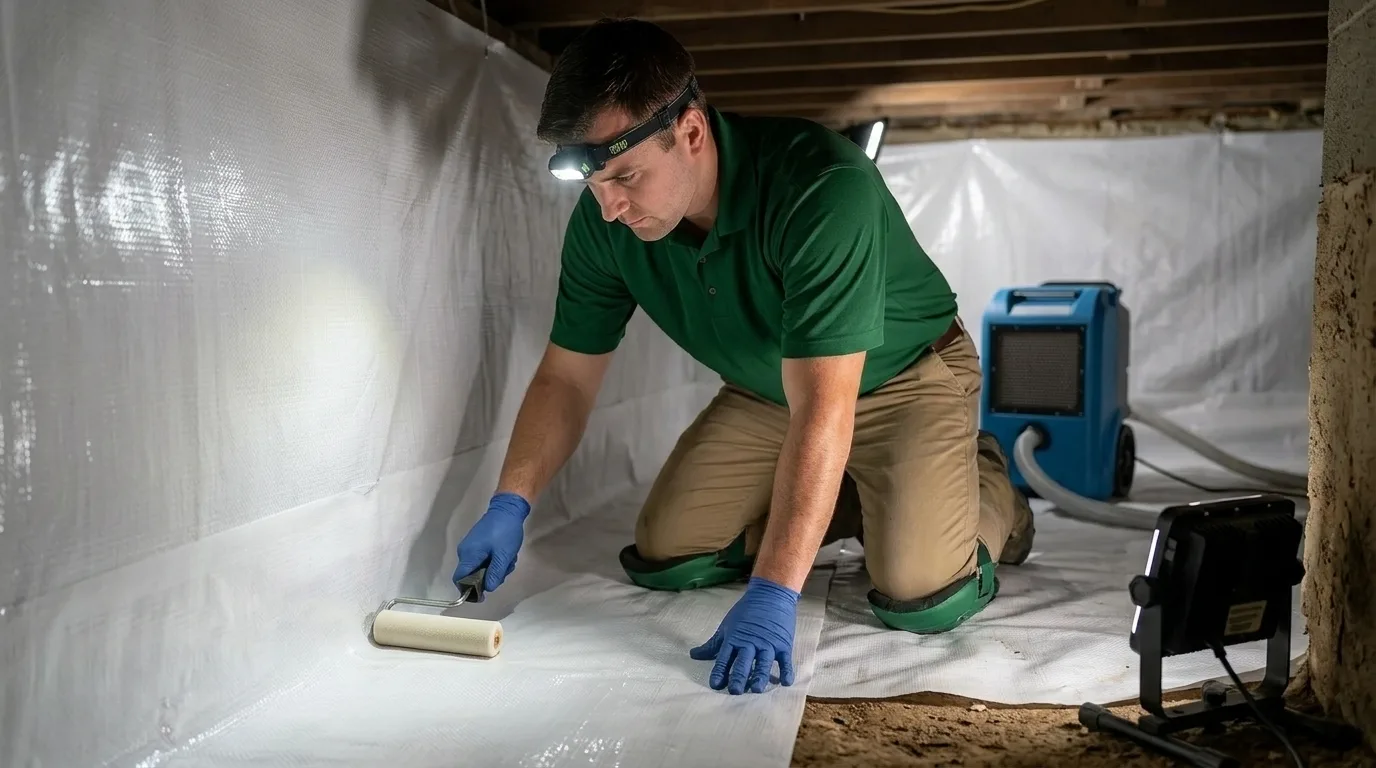
Encapsulation is not a coat of paint or a bag of moisture-absorbing crystals. It is a full conversion of an open, vented crawl space into a sealed, conditioned environment. The work involves lining every square foot of the crawl space floor and the interior faces of the foundation walls with a reinforced polyethylene vapor barrier, typically 12 to 20 mil thick, that is mechanically fastened and seam-taped so no soil moisture can migrate through. Existing foundation vents are sealed from the inside. A crawl space dehumidifier sized to the square footage is installed and wired to a dedicated drain line so it never needs manual emptying.
The result is a crawl space that behaves more like a conditioned basement: relative humidity stays below 55%, wood framing stays dry, and the air that leaks up through your subfloor into the living space is no longer carrying ground moisture, mold spores, or radon. In eastern North Carolina’s climate, where summer dew points routinely sit in the low 70s, that difference is measurable on your energy bill within the first cooling season.
A typical encapsulation project runs one to two days for a standard single-story home. Larger homes, pier-and-beam foundations with irregular footprints, or crawl spaces with standing water or existing mold growth will extend that timeline.
Our process
-
Crawl space inspection and moisture mapping. Before any material goes in, the space is photographed, measured, and assessed for standing water, existing wood decay, mold growth on joists or subfloor sheathing, and pest activity. Moisture readings are taken at multiple points in the wood framing. Any of these conditions need to be addressed before encapsulation, sealing a wet or moldy crawl space traps the problem rather than solving it.
-
Remediation of pre-existing damage. If active mold is found on framing or subfloor, it is treated and removed before the liner goes down. Damaged insulation, which in vented crawl spaces often falls, saturates, and becomes a mold substrate, is bagged and hauled out. This step is skipped by contractors who are selling liner footage, not solving moisture problems.
-
Ground and wall liner installation. The crawl space floor is cleared of debris and graded where possible. The reinforced vapor barrier is rolled out, overlapped at seams by at least 12 inches, and seam-taped with pressure-sensitive foil tape. The liner is run up and mechanically fastened to the foundation walls, typically 6 to 12 inches above grade. Piers and columns are wrapped individually so there are no gaps for moisture to enter.
-
Vent sealing and conditioned air integration. Existing foundation vents are sealed with rigid foam insulation and spray foam at the perimeter. Depending on the home’s HVAC configuration, a small supply duct may be added to introduce a modest amount of conditioned air into the space, or a dedicated crawl space dehumidifier is installed and set to maintain a target relative humidity.
-
Final moisture verification and documentation. After installation, moisture readings are taken again at the same framing points documented in step one. Photographs of the completed liner, sealed vents, dehumidifier installation, and any pre-existing damage that was remediated are compiled into a project file, useful for insurance documentation, real estate disclosure, or future reference.
What separates a good encapsulation from a bad one
The most common failure point is liner thickness. A 6-mil poly sheet, the kind sold at big-box stores, punctures during installation and tears along seams within a year of foot traffic for HVAC servicing. A proper encapsulation uses 12-mil minimum, with 20-mil reinforced liner in crawl spaces where contractors or inspectors will need to walk regularly.
The second failure point is seam integrity. Unsealed or poorly taped seams allow ground moisture to migrate under the liner and accumulate, creating a hidden wet zone that is worse than no liner at all because it is invisible. Every seam should be lapped and taped, not just lapped.
The third, and most consequential, failure is encapsulating over an active moisture problem. Contractors who skip the inspection and go straight to liner installation are sealing in humidity, mold, or wood decay. Insurance adjusters and home inspectors both look for evidence of pre-existing damage that was concealed rather than remediated, which can complicate claims and real estate transactions.
Finally, vent sealing without a conditioned air strategy is a partial solution. A sealed crawl space that has no dehumidification or conditioned air supply can still accumulate humidity during shoulder seasons when the HVAC runs infrequently. Sizing the dehumidifier to the actual cubic footage of the space, not just the square footage, matters.
What does crawl space encapsulation cost?
Typical costs run from a few hundred dollars for minor vapor barrier repairs to several thousand for a full encapsulation with dehumidification. Most homeowners pay somewhere in the following ranges depending on scope:
| Scenario | Typical range |
|---|---|
| Basic ground-only vapor barrier (no wall liner, no vents sealed) | $1,500 – $3,000 |
| Full encapsulation, standard crawl space (under 1,500 sq ft) | $3,500 – $6,500 |
| Full encapsulation with crawl space dehumidifier | $5,000 – $9,000 |
| Encapsulation following mold remediation or water intrusion | $6,500 – $14,000+ |
| Large or complex crawl space (irregular piers, limited access) | $8,000 – $15,000+ |
Every crawl space is different, access height, existing damage, square footage, and whether remediation is needed all affect the final number. Go Agree Restoration of NC provides a written scope of work before any work begins, so there are no surprises on the final invoice. Homeowners insurance typically does not cover elective encapsulation, but it may cover encapsulation performed as part of a covered water damage or mold remediation claim, documentation of the underlying loss is key.
Seasonal and regional considerations
Central North Carolina’s climate makes crawl space moisture a year-round concern, but the pressure peaks in two windows. The first is late spring through August, when outdoor dew points are high enough that any air entering through foundation vents deposits liquid moisture on cooler surfaces inside the crawl space, ductwork, joists, and the underside of subfloor sheathing. The second window is late fall, when warm interior air migrates downward into a cooling crawl space and condenses.
Middlesex and the surrounding Johnston, Nash, and Wake County areas sit on clay-heavy soils that drain slowly and hold ground moisture close to the surface for days after rain events. Homes built before 2000 in this region were almost universally built with vented crawl spaces, a code standard that has since been revised, which means the housing stock here has a higher-than-average rate of crawl space moisture problems compared to newer construction.
Service area
Go Agree Restoration of NC is based in Middlesex and serves homeowners and property managers throughout the surrounding area, including communities in Wake, Nash, Johnston, Wilson, and Edgecombe counties. Individual service-area pages cover specific cities, if you found this page from a search for a neighboring town, you’re in the right place.
If you’ve noticed the signs, soft floors, persistent musty odor, high humidity readings indoors, or a home inspector’s report flagging crawl space moisture, call (919) 906-5473 to schedule a crawl space inspection and get a written encapsulation scope.
Frequently Asked Questions
Does homeowners insurance cover crawl space encapsulation?
Should foundation vents be sealed as part of encapsulation, and won't that cause other problems?
How thick does the vapor barrier need to be, and does it really matter?
What happens if there is already mold on the joists or subfloor — can you still encapsulate?
How do I know if my crawl space needs encapsulation versus just a basic vapor barrier?
Looking for the best crawl space encapsulation company in Middlesex?
Go Green Restoration of NC provides crawl space encapsulation in Middlesex, NC and the surrounding area. We answer calls 24/7 — call (919) 906-5473 for immediate help.
Need Crawl Space Encapsulation now?
We respond 24/7 across Middlesex and surrounding NC cities.
Related Coverage
- Our Restoration Services
- Contact Go Green Restoration of NC
- Crawl Space Encapsulation in Durham
- Crawl Space Encapsulation in Raleigh
- Crawl Space Encapsulation in Rocky Mount
- Crawl Space Encapsulation in Smithfield
- Crawl Space Encapsulation in Wake Forest
- Crawl Space Encapsulation in Wilson
- Crawl Space Encapsulation in Zebulon