
Crawl Space Encapsulation in Wake Forest
Crawl space encapsulation in Wake Forest, NC. Insurance billing accepted. Call (919) 906-5473.
Our technicians are dispatched from our Middlesex, NC headquarters and are typically on-site in Wake Forest within 60 minutes of your call.
Wake Forest sits in a stretch of the North Carolina Piedmont where warm, humid summers and clay-heavy soils create near-perfect conditions for moisture to accumulate beneath a home. That combination, high ambient humidity pushing into the low 80s from June through September, ground that holds water rather than draining it, and a fast-growing housing stock that ranges from 1970s ranch-styles to brand-new construction in subdivisions off Capital Boulevard, means crawl spaces here work harder than in drier climates. Crawl space encapsulation addresses that problem at the source, sealing the space against ground moisture and outside air before wood rot, mold, or pest damage can take hold.
Why Wake Forest Properties See Crawl Space Moisture Problems
The Wake County clay soils that underlie much of Wake Forest don’t drain quickly after heavy rain. Water that can’t move downward moves sideways, and some of it evaporates upward through a bare dirt crawl space floor. During a typical summer, a single square foot of exposed soil can release more than a quart of water vapor per day into the crawl space. Multiply that across a 1,200-square-foot footprint and you’re looking at serious moisture loading before a single pipe has leaked or a storm has flooded anything.
Older neighborhoods with homes built in the 1970s and 1980s tend to have vented crawl spaces that were code-compliant at the time but are now understood to make moisture problems worse in humid climates like ours. Vents that were designed to let air flow through instead draw in warm, saturated outside air, air that cools against the subfloor and drops its moisture load directly onto floor joists and insulation. Newer construction in rapidly developing corridors around Wake Forest isn’t immune either; builder-grade vapor barriers are often thin poly sheeting that tears during inspections or pest treatments, leaving gaps that defeat the purpose.
Our Crawl Space Encapsulation Process in Wake Forest
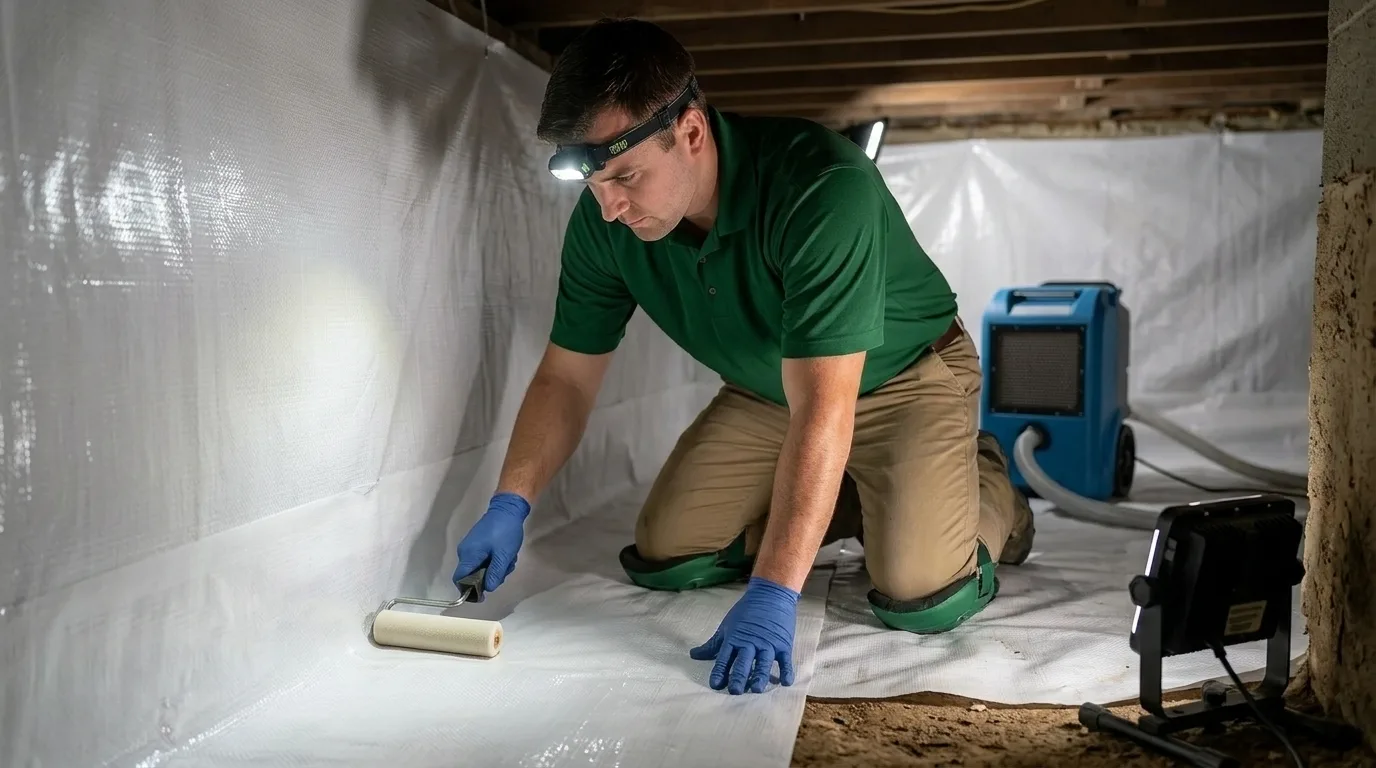
Encapsulation done correctly is a multi-step process, not just rolling out plastic. The work starts with a thorough inspection of the crawl space, checking for standing water, existing mold or wood rot on joists, damaged insulation, and the condition of any existing vapor barrier. If active moisture damage is present, that’s addressed before sealing anything in.
Once the space is clear, the floor and walls are lined with a reinforced polyethylene barrier, typically 12- to 20-mil thickness depending on soil conditions and foot traffic in the space. Seams are overlapped and taped, and the barrier runs up the foundation walls and is sealed at the rim joist. Vents are closed and sealed; in a properly encapsulated crawl space, outside air is no longer welcome. A dehumidifier sized to the square footage is installed and set to maintain relative humidity below 55%, the threshold above which mold can colonize wood surfaces. Drainage matting is added in areas where ground water intrusion is a recurring issue.
The result is a conditioned crawl space that behaves more like a basement than an outdoor space, stable temperature, controlled humidity, and no exposed soil releasing moisture into the structure above.
Reaching Wake Forest from Middlesex
The Go Agree Restoration team is based in Middlesex, NC, which puts Wake Forest well within our regular service area. US-264 East to US-64 West connects our shop to the Wake Forest area efficiently, and we’re familiar with the local road patterns whether a job is closer to the downtown area near South White Street or further out toward the newer developments along Rogers Road and Burlington Mills Road. When you call (919) 906-5473 to schedule an inspection or encapsulation project, we’ll give you a straightforward estimate of when we can be on-site based on current scheduling.
Local Note
Something worth knowing if your home is in one of Wake Forest’s newer planned communities: many HOAs in this area require permits for any work that modifies the crawl space ventilation system, because closing foundation vents technically changes the structure’s original building permit conditions. Wake County does require a permit for crawl space encapsulation in most cases, specifically when vents are being sealed and a mechanical dehumidifier is being added to a conditioned space. We pull the necessary permits as part of the job so the work is documented correctly, which also matters if you sell the home and the buyer’s inspector asks about the encapsulation.
What Encapsulation Protects Against Long-Term
A sealed crawl space does more than control humidity. It reduces the energy load on your HVAC system because conditioned air from the living space above isn’t losing heat or cooling to an uncontrolled crawl space. It removes the damp, dark environment that subterranean termites and other wood-destroying insects prefer. And it protects the structural integrity of floor joists and beams that, once compromised by wood rot, are expensive to sister or replace.
For Wake Forest homeowners who have noticed soft spots in flooring, musty odors that seem to come from nowhere, or HVAC systems that run longer than they should, the crawl space is often the first place to look.
If you’re ready to get a clear picture of what’s happening under your home, call Go Agree Restoration of NC at (919) 906-5473 to schedule a crawl space inspection in Wake Forest. We’ll walk you through what we find and what encapsulation would involve for your specific property, no pressure, just an honest assessment.
Crawl Space Encapsulation in Wake Forest: Service Coverage
Frequently Asked Questions
How fast can you arrive for crawl space encapsulation in Wake Forest?
Does Wake County require a permit for crawl space encapsulation in Wake Forest?
My Wake Forest home was built in the 1980s with vented crawl space vents. Is encapsulation still the right solution?
How does Wake Forest's clay soil affect how encapsulation is done compared to sandier areas of NC?
Will encapsulation help with the musty smell in my Wake Forest home?
What does a crawl space encapsulation project in Wake Forest typically involve from start to finish?
Will my homeowners insurance cover crawl space encapsulation in Wake Forest?
Crawl Space Encapsulation response in Wake Forest
Most Wake Forest calls see a technician on-site within 60 minutes from our Middlesex headquarters.