
Crawl Space Encapsulation in Raleigh
Crawl space encapsulation in Raleigh, NC. Insurance billing accepted. Call (919) 906-5473.
Our technicians are dispatched from our Middlesex, NC headquarters and are typically on-site in Raleigh within 60 minutes of your call.
Raleigh’s humid subtropical climate, long, muggy summers and soils that hold moisture well into fall, creates conditions where an unencapsulated crawl space doesn’t just stay damp, it actively pulls ground moisture upward into your floor joists, insulation, and living space. Homes across the city, from the brick ranches of North Hills to the older bungalows near Five Points, routinely show wood rot, musty odors, and elevated indoor humidity that trace directly back to an open, vented crawl space. Crawl space encapsulation seals that moisture pathway at the source before it becomes a structural or air-quality problem.
Why Raleigh Properties See Crawl Space Moisture Problems
Raleigh sits in Wake County’s piedmont zone, where clay-heavy soils drain slowly and hold groundwater close to the surface for weeks after a significant rain event. That standing moisture has nowhere to go except up, through bare dirt crawl space floors and through the wood framing above them. The city’s average relative humidity hovers above 70% for much of the year, which means even a crawl space that “dries out” between rains never fully dries. It simply cycles between saturated and damp.
The housing stock compounds the problem. Raleigh’s rapid postwar expansion through the 1950s and 1960s produced thousands of pier-and-beam homes with shallow crawl spaces, often less than 24 inches of clearance, that were designed with passive venting standards now considered inadequate. Neighborhoods like Mordecai and Oakwood, where original construction dates back even further, frequently have crawl spaces that have never been professionally addressed. By the time a homeowner notices a soft spot in the floor or a persistent musty smell coming through the HVAC return, moisture damage has often been accumulating for years.
Our Crawl Space Encapsulation Process in Raleigh
Every encapsulation project starts with a thorough crawl space inspection, not a five-minute walk-through, but a systematic assessment of moisture readings at the soil, wood framing, and subfloor levels. We document existing insulation condition, check for standing water or active seepage, and identify any wood rot or mold colonization that needs to be addressed before sealing the space.
From there, the process follows a clear sequence:
- Debris removal and surface prep: Old, fallen insulation, construction debris, and any deteriorated vapor barrier material come out first.
- Drainage and moisture control: If groundwater intrusion is present, interior drainage channels and a sump system are installed before any barrier goes down.
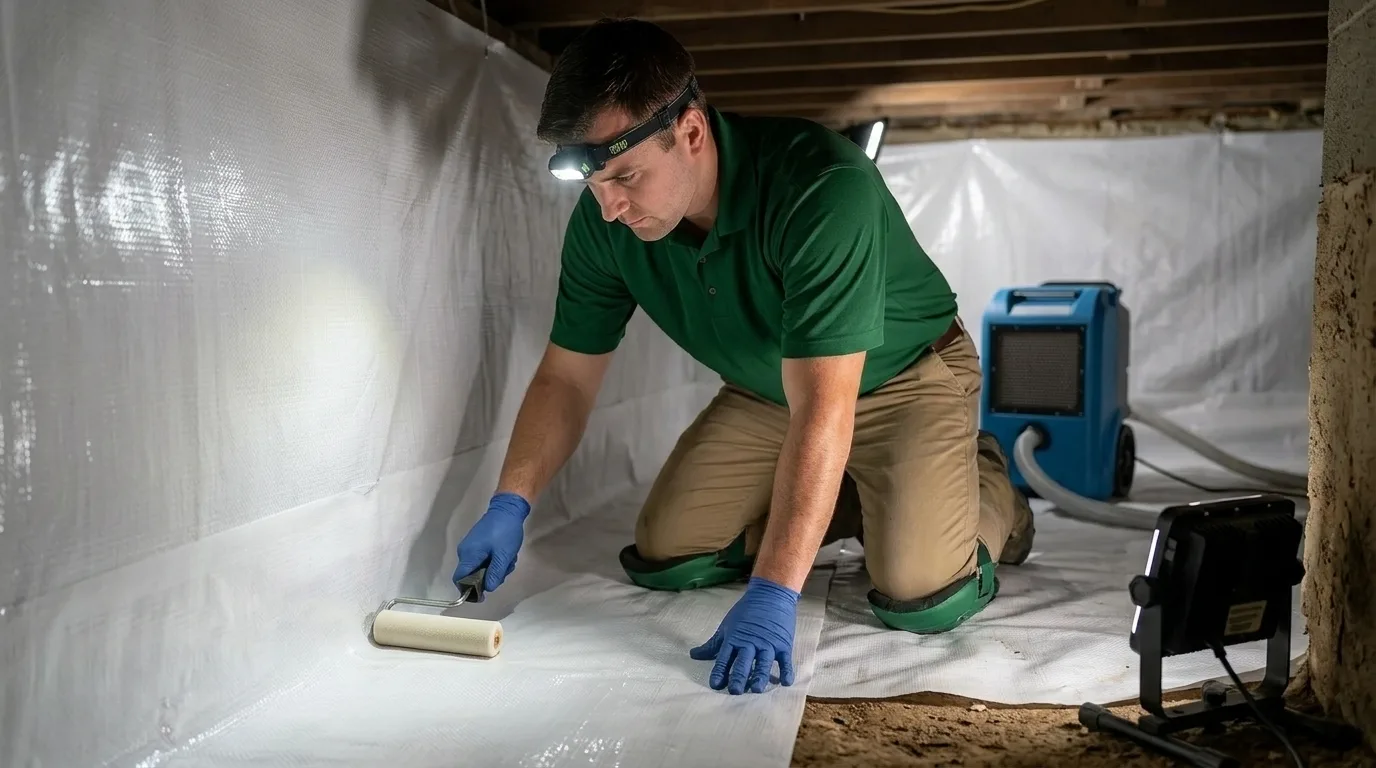
- Heavy-duty vapor barrier installation: We install a reinforced polyethylene liner, typically 20-mil, across the entire crawl space floor and up the foundation walls, sealed at all seams and penetrations. This is the core of encapsulation and where material quality matters most.
- Vent sealing: Existing foundation vents are sealed to convert the crawl space from a conditioned-air-losing, humidity-importing vented space to a sealed, semi-conditioned one.
- Dehumidification: A crawl space-rated dehumidifier is installed and sized to the square footage of the space, ensuring the sealed environment stays below the 55% relative humidity threshold where mold and wood decay stall.
In Raleigh’s climate, skipping the dehumidifier step is a common shortcut that leads to re-encapsulation calls within two to three years. We don’t skip it.
Reaching Raleigh from Middlesex
Go Agree Restoration of NC is based in Middlesex, which puts Raleigh within straightforward reach via US-264 West into the eastern side of the city, or NC-97 connecting to I-440 for access to midtown and west Raleigh neighborhoods. For properties in the 27604 ZIP code, covering areas like Mordecai, Oakwood, and the neighborhoods north of downtown, we’re typically coming in along Capital Boulevard or Person Street depending on traffic.
When you call (919) 906-5473, we’ll confirm scheduling and give you a realistic arrival window based on current workload. We don’t promise response times we can’t back up.
Local Note: Raleigh’s Newer Subdivisions Have Their Own Crawl Space Challenges
It’s easy to assume crawl space moisture is only a problem in older homes, but Raleigh’s construction boom of the 1990s and 2000s produced a large number of tract homes in areas like Brier Creek and parts of northwest Raleigh where builders graded lots quickly and backfilled against foundation walls with soil that settles unevenly. That settling creates low points where water pools against the foundation after heavy rain, a pattern we see repeatedly in homes that are only 20 to 30 years old. The crawl spaces in these homes often have the original builder-grade 6-mil poly sheeting, which degrades, tears, and gaps at seams over time. Replacing that with a properly sealed, heavier-gauge system makes a measurable difference in both moisture readings and indoor air quality.
If your home in Raleigh is showing signs of crawl space moisture, musty odors, higher-than-normal humidity indoors, soft flooring, or visible condensation on ductwork, call Go Agree Restoration of NC at (919) 906-5473 to schedule an inspection. We’ll give you a clear picture of what’s happening under your home and what it will take to fix it for good.
Crawl Space Encapsulation in Raleigh: Service Coverage
Frequently Asked Questions
How fast can you arrive for crawl space encapsulation in Raleigh?
Are older homes in Raleigh's Mordecai and Oakwood neighborhoods more likely to need full encapsulation rather than just a vapor barrier?
Does Raleigh's clay soil actually make crawl space moisture worse than in other parts of North Carolina?
How does encapsulation affect my HVAC system in a Raleigh home?
What does crawl space encapsulation typically cost for a mid-size Raleigh home, and does homeowners insurance cover it?
How long does the encapsulation process take for a typical Raleigh ranch-style home?
Crawl Space Encapsulation response in Raleigh
Most Raleigh calls see a technician on-site within 60 minutes from our Middlesex headquarters.