
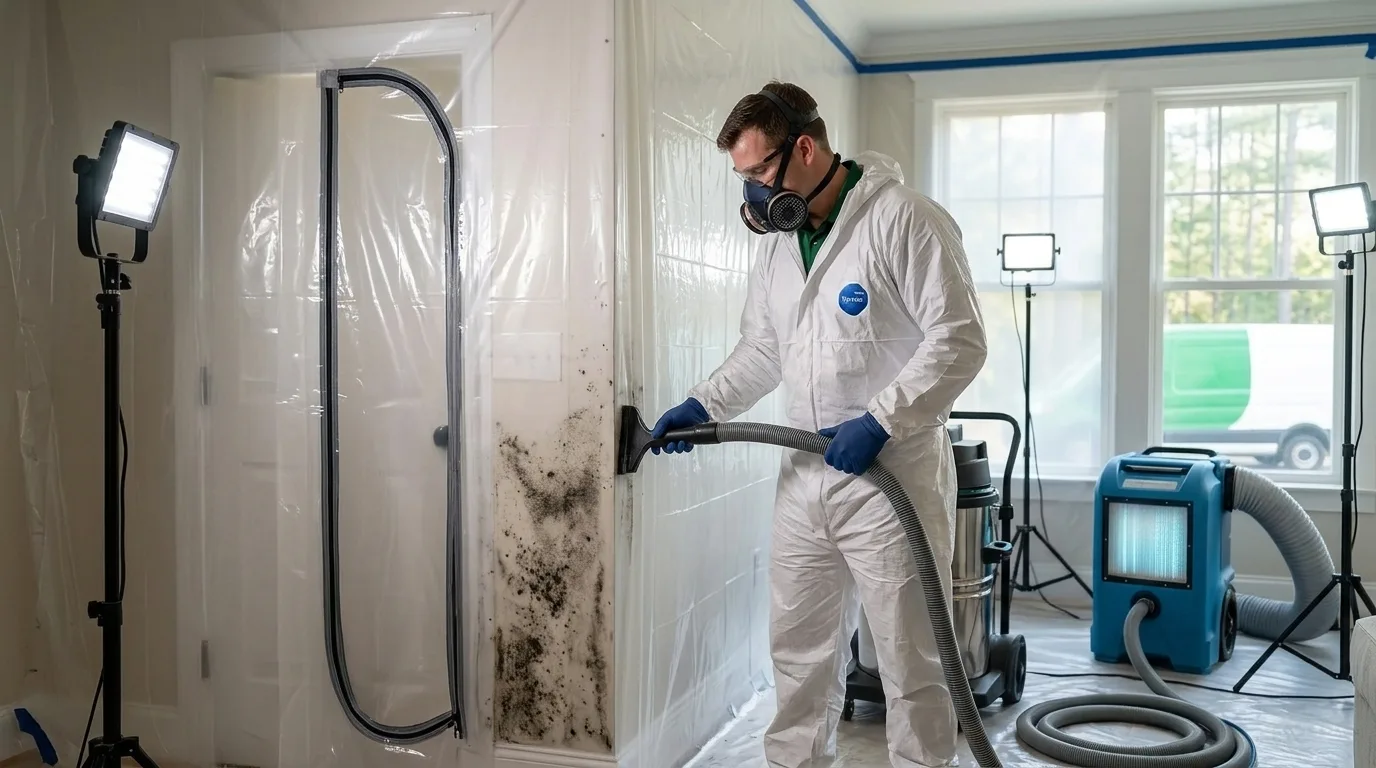
Mold Remediation in Middlesex
Mold remediation in Middlesex and surrounding areas. Insurance billing accepted. Call (919) 906-5473.
You noticed the smell first, that damp, earthy odor coming from behind the drywall or under the bathroom vanity. Then the discoloration appeared: dark patches spreading along the baseboard or ceiling corner that weren’t there last month. Mold doesn’t announce itself until it’s already established a colony, and by the time it’s visible, the spore count in the air is almost always elevated well beyond what a can of spray cleaner can address. Mold remediation is the structured, contained process of removing active growth, treating the affected substrate, and verifying through air testing that the space is safe to reoccupy.
What mold remediation actually involves
Mold remediation is not the same as mold removal, and that distinction matters. Removal implies scrubbing a surface. Remediation means addressing the full scope of the problem: containing the affected area so spores don’t migrate to clean spaces, physically removing or treating colonized materials, filtering the air with HEPA equipment, and then confirming through post-remediation verification (PRV) that spore counts have returned to normal background levels.
The work is hands-on and methodical. Technicians use negative air pressure machines to create a pressure differential inside the containment zone, pulling air through HEPA filters before it exhausts. Porous materials, drywall, insulation, subflooring, wood framing, that have active growth are typically removed rather than cleaned, because mold hyphae penetrate below the surface and cannot be reliably killed in place on porous substrates. Non-porous surfaces like concrete block or metal studs can often be wire-brushed, HEPA-vacuumed, and treated with an EPA-registered antimicrobial. The timeline for a single-room remediation typically runs two to five days from containment setup through clearance testing, depending on the extent of colonization and the drying history of the structure.
Our process
-
Moisture mapping and scope assessment. Before containment goes up, technicians use moisture meters and thermal imaging to trace the water source that fed the mold. Skipping this step is the single most common reason mold returns after remediation, the moisture problem has to be identified and corrected, not just the visible growth.
-
Containment and negative air pressure. Critical barriers of 6-mil poly sheeting seal off the work zone from the rest of the structure. A negative air machine exhausts through HEPA filtration, keeping spores from migrating into adjacent rooms, HVAC ducts, or the living space above.
-
Controlled demolition and physical removal. Colonized drywall, insulation, and other porous materials are double-bagged in poly and removed from the containment through a decontamination chamber. What can be salvaged is HEPA-vacuumed and treated with an EPA-registered antimicrobial agent.
-
HEPA air scrubbing. Air scrubbers run continuously throughout the project and for a dwell period after physical removal, cycling the air in the containment zone multiple times per hour to capture residual airborne spores.
-
Post-remediation verification (clearance testing). An independent air quality sample, or in some cases a visual inspection with tape lift samples, confirms that spore counts inside the remediated area are at or below outdoor background levels before containment comes down and reconstruction begins.
What separates a good mold remediation from a bad one
The most common failure in mold remediation is treating the symptom without fixing the source. A contractor who removes visible growth but leaves an unresolved roof leak, a sweating pipe, or a crawl space with no vapor barrier is guaranteeing a callback in six to eighteen months. Moisture is the only variable that controls mold growth, without it, mold cannot colonize.
A second frequent mistake is inadequate containment. Without negative air pressure and a proper decontamination chamber, the remediation process itself can spread spores to previously unaffected areas of the home. This is especially consequential in homes with forced-air HVAC systems, where a single return vent inside a contaminated zone can distribute spores throughout the entire duct network.
Insurance adjusters and industrial hygienists look for a few specific things in a remediation file: a written scope tied to moisture readings, documentation of the containment setup, a chain-of-custody record for removed materials, and a third-party clearance test result. A remediation that lacks post-remediation verification is difficult to close with an insurer and leaves the homeowner with no documented proof that the work was effective.
Black mold remediation, typically Stachybotrys chartarum, follows the same containment and removal protocol as other mold species, but the presence of Stachybotrys often signals a long-standing moisture problem and may require more extensive demolition to reach colonized framing behind finished surfaces.
What does mold remediation cost?
Typical costs run from a few hundred dollars for a minor surface treatment to well over ten thousand for large-scale mold abatement involving structural materials across multiple rooms. Most homeowners pay somewhere in the middle of that range, with the primary cost drivers being square footage of affected material, the type of substrate involved (drywall versus structural framing), and whether post-remediation reconstruction is included. Every loss is different, Go Green Restoration of NC provides a written scope of work before any remediation begins so there are no surprises.
Homeowners insurance typically covers mold remediation when the growth is a direct result of a covered sudden and accidental water loss, such as a burst pipe or appliance failure. Gradual leaks, flooding, and pre-existing conditions are commonly excluded, though policy language varies.
| Scenario | Typical industry range |
|---|---|
| Single surface area, non-porous substrate (tile, concrete) | $300 – $900 |
| Single room, drywall and insulation removal | $1,500 – $4,000 |
| Crawl space mold abatement with vapor barrier | $2,500 – $6,500 |
| Attic mold remediation (sheathing treatment) | $2,000 – $7,000 |
| Multi-room remediation with structural framing involved | $6,000 – $15,000+ |
Seasonal and regional considerations
North Carolina’s climate creates near-ideal conditions for mold growth across a long window each year. Relative humidity in the Piedmont and eastern counties regularly exceeds 70 percent from late spring through early fall, well above the 60 percent threshold at which mold colonization accelerates on organic building materials. Crawl spaces in older homes throughout the Middlesex area are particularly vulnerable: the combination of warm ground temperatures, humid outdoor air, and limited ventilation creates persistent condensation on floor joists and subfloor sheathing even when there is no active leak.
After tropical systems and named storms move through Johnston, Nash, and Wake counties, the volume of mold calls typically spikes two to three weeks after the event, which is roughly how long it takes for a slow leak or flooded crawl space to produce visible surface growth under summer humidity conditions.
Service area
Go Green Restoration of NC is based in Middlesex, NC and serves homeowners and property managers throughout the surrounding region, including communities in Nash, Johnston, and Wake counties. The city-specific mold remediation pages for nearby areas link back to this page for the full technical detail on process and standards.
If you are seeing visible growth, detecting an unexplained musty odor, or dealing with a recent water loss that was not fully dried out, call (919) 906-5473 to request an air quality assessment and written scope, before the colony spreads further into the wall cavity.
Frequently Asked Questions
Does homeowners insurance cover mold remediation?
What level of mold contamination requires full containment with negative air pressure?
What is post-remediation verification, and do I really need it?
How long does mold remediation take from start to finish?
Can mold grow back after professional remediation?
Looking for the best mold remediation company in Middlesex?
Go Green Restoration of NC provides mold remediation in Middlesex, NC and the surrounding area. We answer calls 24/7 — call (919) 906-5473 for immediate help.
Need Mold Remediation now?
We respond 24/7 across Middlesex and surrounding NC cities.
Related Coverage
- Our Restoration Services
- Contact Go Green Restoration of NC
- Mold Remediation in Durham
- Mold Remediation in Raleigh
- Mold Remediation in Rocky Mount
- Mold Remediation in Smithfield
- Mold Remediation in Wake Forest
- Mold Remediation in Wilson
- Mold Remediation in Zebulon
- How To Choose a Restoration Company in (Without Getting Burned)
- How To Test for Mold in Your Home (DIY Kits vs a Pro Inspection)
- 7 Signs You Have Hidden Mold (and What To Do Next)