
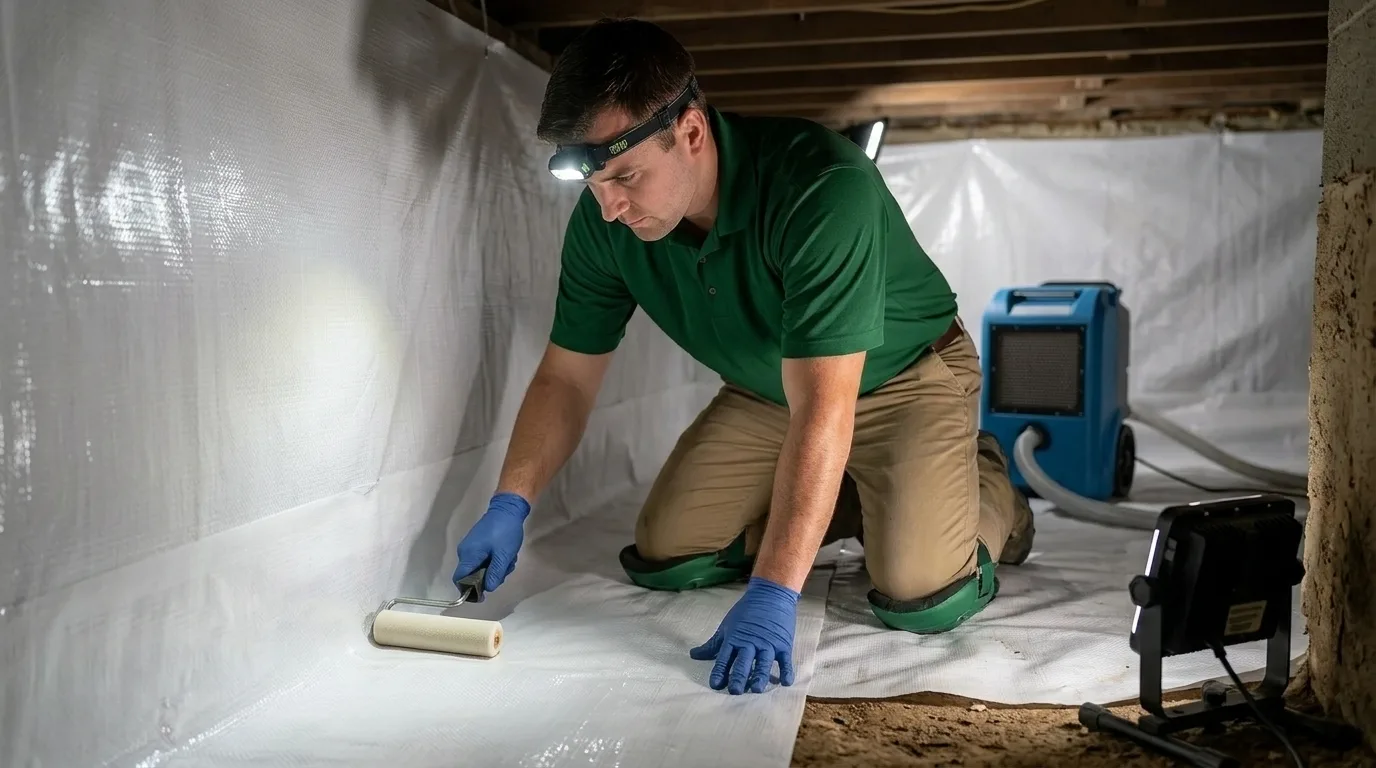
Crawl Space Encapsulation in Smithfield
Crawl space encapsulation in Smithfield, NC. Insurance billing accepted. Call (919) 906-5473.
Our technicians are dispatched from our Middlesex, NC headquarters and are typically on-site in Smithfield within 60 minutes of your call.
Smithfield sits in the heart of Johnston County, where the Neuse River floodplain and a climate that swings between humid summers and wet winters creates exactly the kind of persistent ground moisture that crawl spaces were never designed to handle alone. Homes throughout the area, many of them built in the mid-twentieth century on pier-and-beam foundations, routinely develop standing water, wood rot, and musty odors that creep upward into living spaces long before a homeowner notices anything is wrong. Crawl space encapsulation addresses that problem at the source, sealing the ground and foundation walls against the moisture cycle that Johnston County’s soil and weather keep feeding.
Why Smithfield Properties See Crawl Space Moisture Problems
Johnston County’s soil composition is a significant part of the story. Much of the land around Smithfield is underlain by clay-heavy soils that drain poorly after rain. When the ground stays saturated, which happens regularly after storms move up from the coast, water vapor migrates upward through bare dirt crawl space floors and condenses on floor joists, insulation batts, and HVAC ductwork running beneath the house. The relative humidity in an unencapsulated crawl space here can stay above 70 percent for weeks at a stretch during spring and fall, which is the threshold at which mold begins colonizing wood surfaces within 24 to 48 hours.
Older housing stock compounds the issue. Homes built before 1975, a common vintage in established Smithfield neighborhoods, typically have vented crawl spaces designed around building science that has since been revised. Those foundation vents were meant to flush out humidity, but in a humid climate like this one they often do the opposite: they pull in warm, moist outside air that then condenses when it hits the cooler surfaces below the floor deck. Encapsulation closes those vents and replaces the old passive ventilation model with a sealed, conditioned or dehumidified environment.
Our Crawl Space Encapsulation Process in Smithfield
Every encapsulation project starts with a thorough inspection of the crawl space before any materials go down. That means checking for existing standing water, assessing the condition of floor joists and rim joists for rot or mold, and measuring current humidity levels. If there is active wood decay or microbial growth, that work is addressed first, encapsulating over a damaged structure traps the problem rather than solving it.
Once the space is clean and dry, the process moves in a deliberate sequence:
- Ground cover installation: A heavy-duty polyethylene vapor barrier, typically 20-mil reinforced liner, is laid across the entire crawl space floor and lapped up the foundation walls, overlapped and sealed at seams with moisture-resistant tape.
- Foundation wall sealing: The liner is mechanically fastened and sealed to the foundation walls, closing off the primary pathway for ground moisture and outside air.
- Vent sealing: Existing foundation vents are closed and sealed. In Johnston County homes, this step often reveals vents that have been partially blocked by debris or damaged by previous pest activity.
- Drainage and dehumidification: Depending on the site’s drainage profile, a crawl space dehumidifier, a sump pump, or both may be installed to manage any residual moisture load. Given how frequently Smithfield sees heavy rainfall events, a sump system is often the right call even when standing water is not currently present.
Reaching Smithfield from Middlesex
Go Agree Restoration of NC is based in Middlesex, which puts the team on US-264 East toward Smithfield in a straightforward drive through Wilson’s Mills. For properties in the 27577 ZIP code, which covers most of Smithfield proper, the route is direct and avoids the congestion that can slow response on I-40 during peak hours. Scheduling is handled by phone at (919) 906-5473, and the team works to fit crawl space inspections and project start dates around your availability.
Local Note
One pattern that comes up repeatedly in Smithfield-area crawl spaces: homes near the low-lying stretches along the Neuse River corridor often have crawl spaces that were filled or partially graded with sandy river-bottom soil during original construction. That material drains faster than the surrounding clay, which sounds helpful, but it also means moisture wicks upward more readily through capillary action when the water table rises after heavy rain. A standard 6-mil poly sheet, which meets minimum code, is not enough in those conditions. Thicker reinforced liner and a perimeter drainage channel make a meaningful difference in how the encapsulation performs over time in those specific locations.
If you have noticed a musty smell in your Smithfield home, soft spots in your floor, or higher-than-expected energy bills, all common signs of an uncontrolled crawl space, call (919) 906-5473 to schedule an on-site assessment. The team at Go Agree Restoration of NC will walk through the space with you, explain what they find, and give you a clear picture of what encapsulation involves for your specific property before any work begins.
Crawl Space Encapsulation in Smithfield: Service Coverage
Frequently Asked Questions
How fast can you arrive for crawl space encapsulation in Smithfield?
How does Smithfield's climate affect how long a crawl space encapsulation lasts?
My Smithfield home was built in the 1960s and still has the original foundation vents. Does that change the encapsulation scope?
Is a sump pump always necessary for homes in the 27577 ZIP code area?
What is the difference between a vapor barrier and full encapsulation, and which does my Smithfield home need?
Can crawl space encapsulation help with the musty smell that comes up through the floors in older Smithfield homes?
Will my homeowners insurance cover crawl space encapsulation in Smithfield?
Crawl Space Encapsulation response in Smithfield
Most Smithfield calls see a technician on-site within 60 minutes from our Middlesex headquarters.