
Mold Remediation in Wake Forest
Mold remediation in Wake Forest, NC. Insurance billing accepted. Call (919) 906-5473.
Our technicians are dispatched from our Middlesex, NC headquarters and are typically on-site in Wake Forest within 60 minutes of your call.
Wake Forest sits at the edge of the North Carolina Piedmont where warm, humid summers and clay-heavy soils create conditions that push moisture into crawl spaces and lower-level walls faster than most homeowners expect. When a slow roof leak or a sweating HVAC line goes unnoticed for even 48 to 72 hours, mold colonies can establish themselves behind drywall or under subfloor sheathing before the smell ever reaches the living area. Mold remediation here isn’t a one-size-fits-all job, the local building stock, the regional humidity curve, and the specific way Wake Forest homes were constructed all shape how the work gets done.
Why Wake Forest Properties See Mold Issues
Wake Forest experienced a significant residential building boom through the late 1990s and 2000s, and a large share of that housing used engineered wood products, OSB sheathing, LVL beams, and composite subfloors, that absorb moisture faster than older solid lumber and can begin to delaminate before visible mold is obvious. Crawl space construction is extremely common in this part of Wake County, and unencapsulated or poorly ventilated crawl spaces trap ground moisture year-round. During July and August, outdoor relative humidity in the Wake Forest area regularly climbs above 80%, which means even a small vapor intrusion event can push crawl space humidity well past the 60% threshold where mold growth accelerates.
The clay-rich soil throughout the area also drains slowly after heavy rain. When grading around a foundation settles over time, common in neighborhoods that were developed quickly during the growth years, water pools against foundation walls and wicks inward. Finished basements and bonus rooms built over garages, common in the subdivisions off Burlington Mills Road and in the Heritage community, are classic moisture traps in this region’s housing stock, and a musty odor is usually the first sign that one of them has been collecting moisture.
Our Mold Remediation Process in Wake Forest
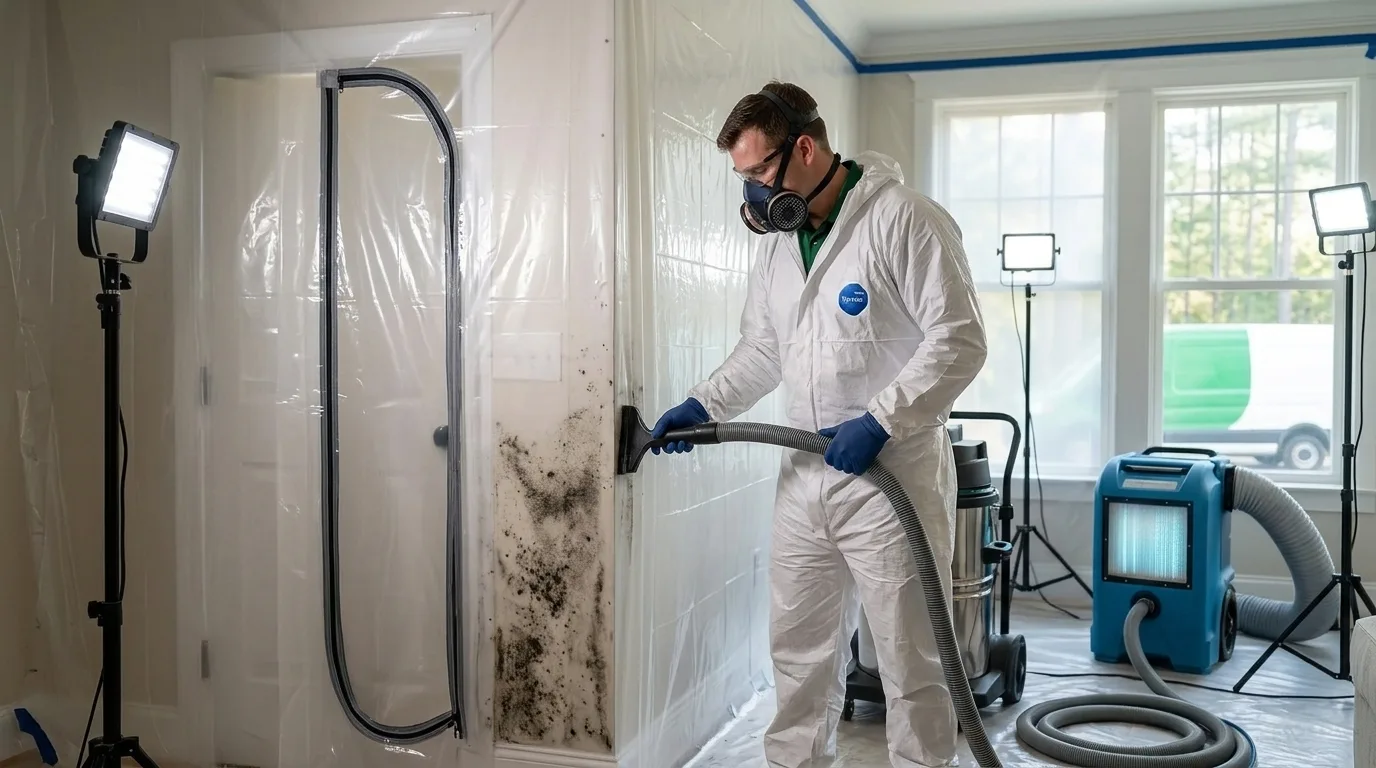
Every job starts with a thorough moisture mapping inspection, not just a visual scan. We use thermal imaging and pin-type moisture meters to trace the water source that fed the mold, because removing mold without fixing the moisture pathway means the problem returns within a season. Once the source is identified and controlled, we establish containment using negative air pressure and 6-mil poly barriers to prevent spores from migrating to clean areas of the home during the removal process.
Affected porous materials, drywall, insulation, carpet padding, are removed, double-bagged, and disposed of per North Carolina solid waste guidelines. Structural wood surfaces are HEPA-vacuumed, treated with an EPA-registered antimicrobial, and dried to manufacturer-specified moisture content before any reconstruction begins. Air scrubbers with HEPA filtration run continuously throughout the project. For homes in the 27587 ZIP code area with encapsulated crawl spaces, we pay particular attention to the liner seams and pier wrap, those are the spots where moisture most commonly re-enters after a remediation if they aren’t properly resealed.
Reaching Wake Forest from Middlesex
Our team operates out of Middlesex, NC, which puts Wake Forest roughly 30 to 40 minutes away via US-264 East to US-64 West, or through Zebulon on NC-96 North depending on traffic. We schedule prompt arrival windows and confirm the appointment time so you’re not waiting on a vague four-hour window. For properties in the Heritage subdivision or along the northern edge of town near Falls Lake State Recreation Area, the NC-98 Bypass is typically the fastest approach and keeps our equipment vehicles off the narrower residential streets.
Wake Forest Insurance Coordination
Mold claims in Wake County can be complicated because standard homeowner policies often distinguish between “sudden and accidental” water damage and long-term seepage, and insurers will scrutinize the timeline. We document the affected area with written moisture readings, photographs, and a scope of work that clearly ties the mold growth to a specific moisture event. That documentation package is formatted to meet what most major carriers require for a mold remediation claim, and we communicate directly with adjusters to keep the process moving. If your HOA in Heritage or another planned community requires a post-remediation clearance test, we coordinate that inspection with an independent third-party industrial hygienist before we close out the job.
Local Note
One pattern we see consistently in Wake Forest homes built between 1998 and 2008: the HVAC systems in those houses were often sized aggressively for large open floor plans, which means they cycle on and off quickly rather than running long enough to dehumidify the air properly. Short-cycling AC units keep temperatures comfortable but leave indoor humidity elevated, sometimes sitting at 55 to 60% all summer. That chronic humidity, even without any visible leak, is enough to feed mold growth inside wall cavities near supply vents and in bonus rooms above garages where insulation is thinner. If we find mold in those locations, we flag the HVAC sizing issue to the homeowner so the root cause gets addressed, not just the symptom.
If you’re noticing a musty smell, discoloration on drywall, or unexplained allergy symptoms in your Wake Forest home, the right next step is an inspection, not a wait-and-see approach. Call Go Agree Restoration of NC at (919) 906-5473 to schedule a mold assessment and get a clear picture of what’s happening inside your walls before the problem spreads further.
Mold Remediation in Wake Forest: Service Coverage
Frequently Asked Questions
How fast can you arrive for mold remediation in Wake Forest?
How long does mold remediation typically take in a Wake Forest crawl space home?
Are homes in the Heritage community more prone to mold than other Wake Forest neighborhoods?
Does Wake Forest's humid climate affect how long it takes to dry out materials after mold removal?
What does the mold remediation process involve for a finished basement in the 27587 ZIP code area?
Will my homeowner's insurance cover mold remediation in my Wake Forest home, and how do you help with the claim?
Mold Remediation response in Wake Forest
Most Wake Forest calls see a technician on-site within 60 minutes from our Middlesex headquarters.