
Mold Remediation in Durham
Mold remediation in Durham, NC. Insurance billing accepted. Call (919) 906-5473.
Our technicians are dispatched from our Middlesex, NC headquarters and are typically on-site in Durham within 60 minutes of your call.
Durham’s mix of humid Piedmont summers, aging housing stock, and the clay-heavy soils common across much of the city creates conditions where mold doesn’t just appear, it spreads fast and quietly. A slow roof leak over a crawl space in Old North Durham or condensation building up inside a poorly ventilated bathroom in Watts-Hillandale can seed a colony in as little as 24 to 48 hours. By the time you smell something musty or notice discoloration on drywall, the growth is often well behind the surface.
Why Durham Properties See Mold Issues
Durham sits in a climate band that delivers hot, sticky summers and mild but damp winters, a combination that keeps indoor humidity elevated for much of the year. That baseline moisture load is compounded by the city’s housing stock. A significant portion of homes in neighborhoods like Northgate Park, Burch Avenue, and the streets surrounding Duke’s East Campus were built before 1960, when vapor barriers in crawl spaces were either minimal or nonexistent. Those crawl spaces sit directly on Durham’s red clay soil, which holds water long after a rainstorm and releases it slowly as humidity.
The result: ground-level and below-grade spaces in older Durham homes are chronically damp. Fiberglass batt insulation stapled to floor joists absorbs that moisture and becomes a substrate for mold growth that’s invisible from above. Homeowners in the 27701 and 27705 ZIP codes, which cover much of central and west Durham, call about musty odors in finished basements and first-floor rooms more often than almost any other mold complaint we hear from this part of the Triangle.
Our Mold Remediation Process in Durham
Every job starts with a thorough assessment, not just a visual scan, but moisture readings taken at multiple points across affected materials. In Durham’s older homes, that means probing floor joists, wall cavities behind tile, and the underside of subfloor sheathing, not just the visible surface.
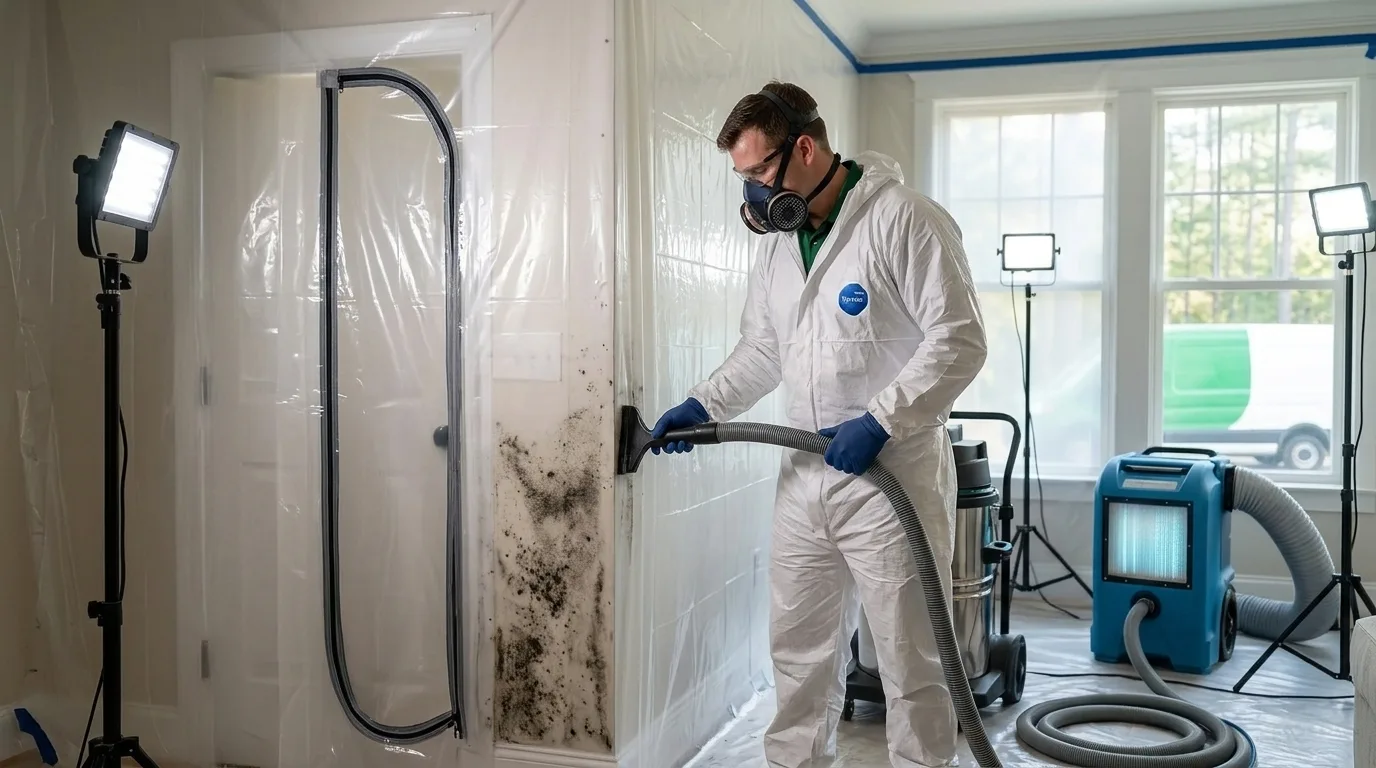
Once the scope is clear, we establish containment. Negative air pressure and physical barriers keep spores from migrating into unaffected living spaces during the removal process. Affected porous materials, drywall sections, insulation batts, wood framing that has exceeded safe moisture thresholds, are removed, bagged, and disposed of according to North Carolina solid waste guidelines. Non-porous surfaces are HEPA-vacuumed, treated with an EPA-registered antimicrobial, and dried to confirmed low moisture levels before any reconstruction begins.
We don’t close out a job until post-remediation clearance readings support it. If a property owner or their lender requires independent air quality testing, we coordinate the scheduling with a third-party industrial hygienist rather than self-certifying.
Reaching Durham from Middlesex
Go Agree Restoration operates out of Middlesex, NC, which puts Durham roughly 35 to 45 minutes away via US-264 West and I-885 North depending on traffic. For properties in the southern part of the city, near South Square or the neighborhoods off Fayetteville Road, routing through US-70 West is often faster. Scheduling is handled promptly; call (919) 906-5473 to discuss availability and get a same-day or next-day assessment on the calendar.
Durham Insurance & HOA Coordination
Mold claims in Durham frequently intersect with homeowners insurance disputes over causation, insurers want to know whether the mold resulted from a sudden covered event like a burst pipe or from long-term moisture intrusion, which many policies exclude. Thorough documentation at the assessment stage matters enormously here. We photograph moisture readings, map affected areas, and generate written scope reports that give your adjuster a clear picture of origin and extent.
For properties in HOA-governed communities, particularly newer townhome developments along the 15-501 corridor or in the Research Triangle Park-adjacent neighborhoods in southern Durham, remediation scope sometimes requires HOA approval before structural materials can be removed. We’ve worked through those coordination steps before and can help you understand what documentation the association is likely to need.
Local Note
One pattern that comes up repeatedly in Durham’s pre-1970 bungalows and ranch homes is mold growth behind original ceramic tile in bathrooms, not on the grout lines you can see, but on the wood lath or early-generation cement board behind the tile. The tile face looks intact; the problem is entirely hidden. When moisture readings on a bathroom wall are elevated but there’s no visible surface growth, that’s often what’s happening. Removing and replacing the tile is the only way to properly address it, and it’s worth knowing before you start a remediation scope so the cost estimate reflects the full picture.
If you’re dealing with a musty smell, visible discoloration, or a recent water event in a Durham home or commercial property, call (919) 906-5473. A proper assessment is the first step, and in a climate like Durham’s, waiting rarely makes the problem smaller.
Mold Remediation in Durham: Service Coverage
Frequently Asked Questions
How fast can you arrive for mold remediation in Durham?
How long does mold remediation typically take in older Durham homes with crawl spaces?
Are homes in the 27701 ZIP code more prone to mold than newer construction elsewhere in Durham?
Does Durham have any local code or permit requirements that affect mold remediation work?
What should I do about a musty smell in a Watts-Hillandale or Northgate Park home before your team arrives?
Will my homeowners insurance cover mold remediation in Durham, and how does the claims process work?
Mold Remediation response in Durham
Most Durham calls see a technician on-site within 60 minutes from our Middlesex headquarters.