
Water Damage Restoration in Raleigh
Water damage restoration in Raleigh, NC. Insurance billing accepted. Call (919) 906-5473.
Our technicians are dispatched from our Middlesex, NC headquarters and are typically on-site in Raleigh within 60 minutes of your call.
Raleigh’s clay-heavy Piedmont soil doesn’t drain the way homeowners expect. When a supply line fails behind a bathroom wall in a North Hills ranch house or a sump pump gives out during one of the area’s fast-moving summer thunderstorms, that water has nowhere to go, it pools under subfloor, wicks into wall cavities, and starts the clock on structural damage faster than most people realize. Go Agree Restoration of NC responds to water damage calls across Raleigh and handles the full scope: water removal, structural drying, and documentation for your insurance claim.
Why Raleigh Properties See Water Damage Issues
Raleigh sits in a transition zone between the humid coastal plain and the drier Piedmont, which means the city absorbs significant rainfall, typically over 46 inches a year, but the red clay subsoil beneath most neighborhoods doesn’t percolate quickly. That combination puts crawl spaces and slab foundations under real pressure after heavy rain events.
The housing stock adds another layer of complexity. Neighborhoods like Hayes Barton and Boylan Heights contain homes built in the 1920s through 1950s, many with original cast-iron or galvanized supply lines that have been patching along for decades. When those pipes finally fail, the water often travels inside wall cavities for hours before anyone notices. Newer construction in areas like North Raleigh and Brier Creek uses PEX and modern vapor barriers, but those homes come with finished basements and tightly sealed building envelopes that trap moisture rather than letting it escape naturally.
Flash flooding is also a recurring issue along Crabtree Creek and its tributaries. Properties near the Crabtree Valley corridor, including parts of the 27612 ZIP code, have seen repeated flood intrusions during back-to-back storm systems, which means some of those homes have underlying moisture problems that compound each new event.
Our Water Damage Restoration Process in Raleigh
Every job starts with a moisture assessment before any equipment is placed. Thermal imaging and calibrated moisture meters map exactly where water has traveled, behind baseboards, under hardwood, inside insulated wall cavities. In older homes like those in Oakwood or Mordecai, this step matters more than usual because plaster-over-lath construction holds moisture differently than modern drywall and can mask saturation that a visual inspection would miss.
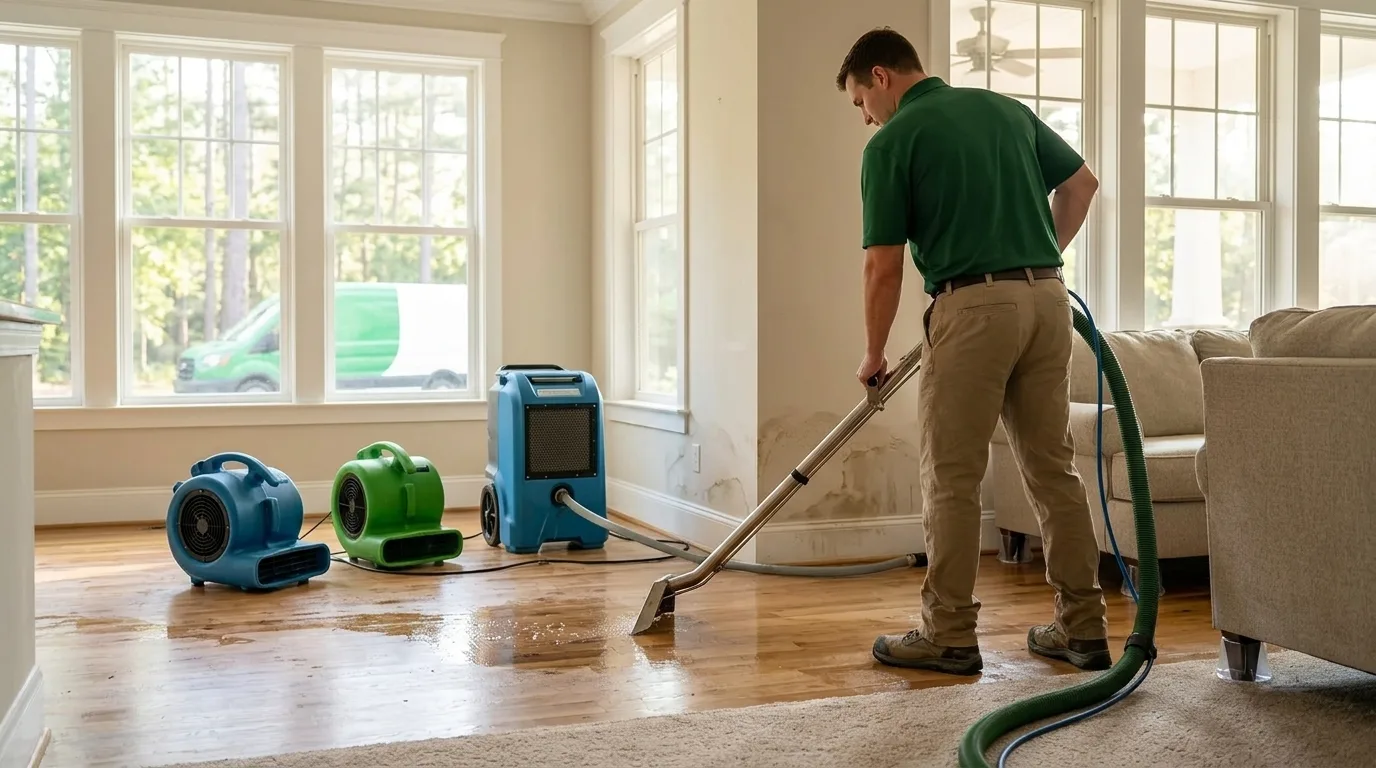
Once the scope is mapped, water extraction begins using truck-mounted and portable extraction units sized to the loss. Standing water comes out first; then the slower work of pulling residual moisture from structural materials begins. Drying equipment, industrial-grade dehumidifiers and axial air movers, is positioned based on the moisture map, not just placed in the center of a room. Readings are logged daily so the drying curve is documented and the equipment is adjusted as materials release moisture.
Before any affected materials are removed or rebuilt, we photograph and document everything for your insurance adjuster. That documentation package, moisture readings, equipment placement logs, photo records, is what keeps a claim from stalling.
Reaching Raleigh from Middlesex
Go Agree Restoration of NC is based in Middlesex, which puts the team on US-264 West toward Raleigh in a straightforward run. Under normal traffic conditions, that route reaches the eastern side of Raleigh, including the 27610 and 27601 corridors, relatively quickly. Getting to the western neighborhoods like Cary-adjacent Brier Creek or the North Hills area means continuing on I-440 or cutting north on US-1, which adds time depending on the time of day.
If you’re calling from downtown Raleigh or the Glenwood South area, be prepared to describe access clearly, some of the older in-fill blocks near the warehouse district have limited street parking for service vehicles, and knowing that in advance helps the crew stage equipment efficiently when they arrive.
Raleigh Insurance Coordination
Most standard homeowners policies in North Carolina cover sudden and accidental water damage, a burst pipe, a washing machine supply line failure, an ice maker line that let go overnight. What they typically do not cover is gradual leakage or maintenance-related deterioration, which is a distinction adjusters look at closely.
The documentation we produce during the drying process is designed to support your claim from the start. Moisture readings with timestamps, equipment logs, and photo evidence of the source and affected materials give your adjuster what they need to process the loss without repeated site visits. We work with most major carriers and can communicate directly with your adjuster on scope and pricing.
Local Note
One pattern that comes up repeatedly on jobs in Raleigh’s older bungalow neighborhoods, particularly in areas like Five Points and Belmont, is that the original hardwood floors were installed directly over board subfloor with no vapor barrier in between. When water gets under those floors, it doesn’t just cup the surface boards; it saturates the subfloor boards beneath, and both layers need to reach drying targets before the floor can be assessed for salvage. Homeowners sometimes see the surface boards flatten out after a few days and assume the problem is solved, but the subfloor can still be holding moisture that will cause secondary mold growth or fastener corrosion months later. Checking both layers before closing out a job is standard practice on these houses.
If you’re dealing with water damage in Raleigh, whether it’s a slow leak that’s been working behind a wall or an acute loss from a failed appliance, call Go Agree Restoration of NC at (919) 906-5473. The sooner extraction and structural drying begin, the more of your home’s original materials can be saved.
Water Damage Restoration in Raleigh: Service Coverage
Frequently Asked Questions
How fast can you arrive for water damage restoration in Raleigh?
How quickly can Go Agree Restoration reach neighborhoods like Hayes Barton or Boylan Heights after a water loss?
Raleigh's older homes in Five Points and Oakwood often have plaster walls — does that change the drying timeline?
Properties near Crabtree Creek in the 27612 ZIP code have flooded more than once — does repeat flooding affect the restoration approach?
What's the difference between water extraction and structural drying, and why do both matter?
Will my North Carolina homeowners insurance cover a burst pipe in Raleigh, and how does the claims process work?
Water Damage Restoration response in Raleigh
Most Raleigh calls see a technician on-site within 60 minutes from our Middlesex headquarters.